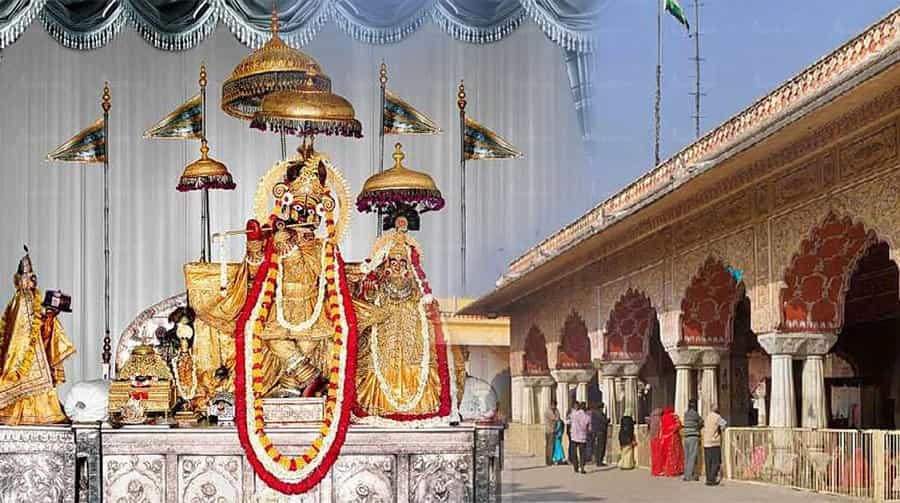
In Jaipur, Rajasthan, Govind Ji Temple is the most famous and holy place of worship and perhaps the most important one in the history of the Rajasthani kings. The temple is dedicated to Lord Govind Dev Ji, who is one of the manifestations of the incarnations of Lord Krishna on Earth and is regarded as the principal deity of the Amber / Amer Kachwaha Dynasty of rulers.
The idol of Govind Ji is believed to look just as Lord Krishna did. Maharaja Sawai Jai Singh, the Maharaja of Jaipur, was a devotee of the Lord and hence had his palace built so that after the idol was transferred from Amer to Jaipur, he could get a glimpse of the Lord directly from his palace.
The temple is thronged by devotees all year round and gets a massive footfall owing to its importance and legend.
Govind Dev Ji Temple Darshan & Aarti Timings |
|
| Aarti | Timings |
| Mangla Aarti | 4:30 am to 5:00 am |
| Dhoop Aarti | 7:30 am to 8:45 am |
| Shringar Aarti | 9:30 am to 10:15 am |
| Rajbhog Aarti | 11:00 am to 11:30 pm |
| Gwal Aarti | 6:45 pm to 8:00 pm |
| Sandhya Aarti | 6:45 pm to 8:00 pm |
| Shayan Aarti | 9:00 pm to 9:30 pm |
History of Govind Dev Ji Temple
The primary god of the Kachwaha Dynasty of Amber is Lord Govind Dev Ji, one of the forms of Lord Krishna, and is identified with the rich history of Jaipur and its rulers.
It is said that the original Govind Dev Ji idol was in a temple in Vrindavan, excavated by a disciple of Sri Chaitanya Mahaprabhu, Srila Rupa Goswami, some 450 years ago from Goma Teela in Vrindavan.
In 1590 A.D, the then Maharaja of Amer, Sawai Man Singh, along with the Mughal Emperor Akbar, constructed a massive temple in Vrindavan, to learn about the life of the temple. The red sandstone used to construct the temple, which was supposed to be used to construct the Agra Fort, was donated by Akbar. The emperor also gave away nearly 135 acres of land for cattle and feed.
The Mughal emperor Aurangzeb was on a binge during the 17th century, razing down Hindu temples and smashing idols. The idol of Govind Ji was taken care of by Shri Shiv Ram Goswami in Vrindavan at the same time. He kept moving the idols from Vrindavan to the Kama in Bharatpur to Radhakund to Govindpura in Sanganer in search of saving the idols.
Since the principal deity of the ruling dynasty was Lord Govind Dev Ji, the then ruler of Amer, Maharaja Sawai Jai Singh took the oath of guarding the idol and installed it in the Amer Valley, later named in 1714 AD as Kanak Vrindavan. They did not, however, put it out in the open because Amer represented the Mughal court at that period and could not afford to hold a standoff with the Mughals.
Govind Ji’s idol was first carried from Amer to Jaipur and installed by Maharaja Sawai Jai Singh at the Surya Mahal in 1735 AD after he received orders from the Lord himself to do so in his dreams. As he assumed the palace belonged to Lord Govind Ji, the Maharaja enshrined the god at Suraj Mahal and he moved his residence to a new palace and called it Chandra Mahal. The Chandra Mahal was constructed in such a manner that Govind Ji’s idol would be accessible to him from the palace.
The Suraj Mahal was later renamed and Govind Ji Temple is known by its present name.
- Suggested to Read: Famous Krishna Temples In India
The legend behind the idol at Govind Dev Ji Temple Jaipur
Legend has it that about 5500 years ago, the great-grandson of Lord Shri Krishna, 13-year-old Bajranabh, after receiving suitable orders from his grandmother about the original looks of the Lord, decided to make an exact idol of the Lord.
Only the feet of the first idol he created were like those of Lord Krishna. This first idol was called ‘Madan Mohan Ji’ by the Lord and is enshrined in Karauli, Rajasthan. Vajranabh made a second idol in which only the chest was exactly like Lord Krishna, and the name of Lord ‘Gopi Nath Ji’ was given to this idol, which is enshrined in Purani Basti, Jaipur, Rajasthan.
It was the third idol that Bajranabh created, which in every way looked exactly like Lord Shri Krishna and was accepted by his grandmother. This final idol became known as ‘Govind Ji’ Lord. Govind Ji’s idol is also named ‘Bajrakrit,’ which means ‘Bajranabh made.’
Architecture and Layout of Govind Dev Ji Temple Jaipur
The Govind Ji Temple is made of sandstone and marble with gold-covered ceilings. There is a combination of Rajasthani, Muslim as well as Classical Indian elements to the style of the temple structure. Since it was constructed next to a royal palace, chandeliers, as well as paintings, adorn the walls. A lush green garden also surrounds the temple and the garden is known by the name,’ Talkatora’ and is ideally suited for children.